34ºc, Sunny

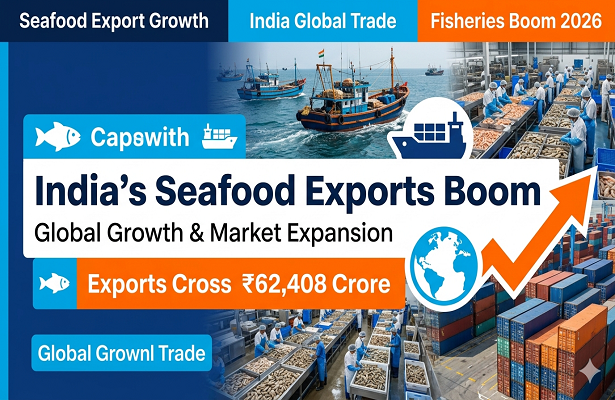
India’s fisheries sector has emerged as a key contributor to food security, employment, export earnings, and sustainable livelihoods. Backed by a record investment of ₹39,272 crore since 2015, the sector now supports nearly 30 million fishermen and fish farmers, with its impact across the value chain being almost double.
As the world’s second-largest aquaculture producer, India contributes nearly 8% to global fish production. The sector has transformed from a traditional activity into a commercially significant industry over the past decade, ensuring inclusive growth for small-scale fishermen.
📈 Rising Production and Export Growth
India’s fish production has witnessed remarkable growth:
- Increased from 141.64 lakh tonnes (2019–20)
- To 197.75 lakh tonnes (2024–25)
- Average annual growth: ~7%
Seafood exports have also shown strong and consistent growth:
- ₹30,213 crore in 2013–14
- ₹62,408 crore in 2024–25
A major share comes from shrimp exports, contributing ₹43,334 crore.
🌍 Global Market Presence
India exports over 350 varieties of seafood products to nearly 130 international markets.
Key export destinations include:
- United States (largest market – 36.42%)
- China
- European Union
- Southeast Asia
- Japan
- Middle East
The export basket is dominated by:
- Frozen shrimp
- Frozen fish
- Squid
- Cuttlefish
- Surimi-based products
- Fresh and chilled seafood
Value-added seafood products have also increased significantly, from 2.5% to 11%, reflecting diversification and higher global demand.
🐟 Government Initiatives Driving Growth
Under the Pradhan Mantri Matsya Sampada Yojana (PMMSY), the government is actively promoting:
- Quality fish seed production
- Expansion of brackish water aquaculture
- Export-oriented species cultivation
- Adoption of advanced technologies
- Disease management and traceability systems
- Capacity building across the value chain
Investments are also being made in:
- Cold chain infrastructure
- Modern fishing harbors
- Fish landing centers
- Post-harvest processing facilities
🧪 Focus on High-Value Species
To diversify exports, India is promoting high-value species such as:
- Tuna
- Seabass
- Cobia
- Pompano
- Mud crab
- Tilapia
- Grouper
- Tiger shrimp
- Scampi
- Seaweed
This strategy aims to expand India’s product portfolio and access premium international markets.
⚖️ Compliance with Global Standards
India is aligning its fisheries sector with international regulations and sustainability standards.
Key developments include:
- Compliance with US Marine Mammal Protection Act (MMPA)
- Approval from US authorities in 2025 for continued exports
- Installation of Turtle Excluder Devices (TEDs) in shrimp trawlers
- Strengthening traceability and certification systems
- Launch of a national digital monitoring framework
These steps ensure food safety, sustainability, and global compliance.
⚙️ Ease of Doing Business Reforms
The government has simplified regulatory processes to support exporters:
- Digitalization of Sanitary Import Permit (SIP) system
- Integration with National Single Window System
- Approval time reduced from 30 days to 72 hours
- Exemptions for research samples and certain imports
These reforms have made the sector more business-friendly and investment-ready.
🔮 Future Roadmap
Over the next five years, India aims to:
- Increase share of value-added seafood exports
- Expand processing capacity and skilled workforce
- Strengthen certification and quality assurance
- Explore new markets like UK, EU, ASEAN, and West Asia
- Develop inland export hubs and freshwater supply chains
With advanced cold chain systems, digital traceability, and strong compliance frameworks, India is poised to emerge as a reliable and premium global seafood exporter.
🧾 Conclusion
India’s seafood sector is witnessing a remarkable transformation, driven by policy support, technological advancements, and global demand. With a strong focus on diversification, sustainability, and quality, the country is rapidly strengthening its position in the global seafood market.