34ºc, Sunny

Date of Release: 21 December 2025 | 4:25 PM
Source: PIB Delhi
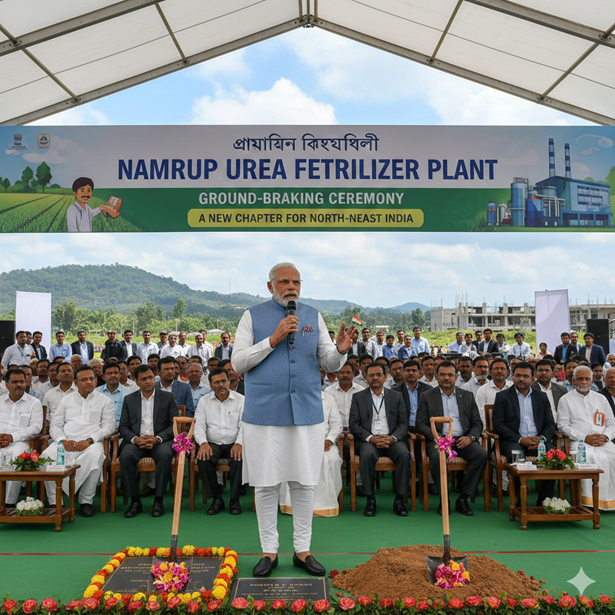
The Prime Minister, Shri Narendra Modi, today addressed a large public gathering at Namrup in Assam on the occasion of the ground-breaking ceremony of the Ammonia–Urea Fertilizer Plant. He described the day as a historic milestone for Assam and the entire North-Eastern region, marking the beginning of a new era of industrial growth, agricultural strength, and employment generation.
Extending his greetings to the Governor of Assam Shri Lakshman Prasad Acharya, Chief Minister Shri Himanta Biswa Sarma, Union Ministers, former Chief Minister Shri Sarbananda Sonowal, Members of Parliament, Members of the Legislative Assembly, and other dignitaries, the Prime Minister paid homage to the great warriors, freedom fighters, and cultural icons of Assam. He expressed deep respect for the land of bravery and sacrifice and conveyed heartfelt gratitude to the people, especially women and tea garden workers, for their affection and blessings.
The Prime Minister said that Namrup and Dibrugarh had been waiting for this moment for decades. With the foundation stone of the fertilizer plant being laid, a new chapter of industrial progress has begun in the region. He also referred to the inauguration of a new terminal at Guwahati Airport earlier in the day, stating that Assam is now moving forward at a new pace of development. He emphasized that these developments are only the beginning and that Assam will play a powerful role in the vision of a Developed India, just as it did during the Ahom era.
Highlighting the importance of the fertilizer sector, the Prime Minister stated that farmers are central to nation-building. Ensuring uninterrupted availability of fertilizers is essential for agricultural growth. The Namrup fertilizer project, with an investment of approximately ₹11,000 crore, will produce more than 1.2 million metric tonnes of urea annually. Local production will improve supply, reduce logistics costs, and strengthen fertilizer availability across Assam and neighboring states.
The Prime Minister noted that the project will generate thousands of employment opportunities, including permanent jobs once the plant becomes operational, as well as indirect employment in construction, maintenance, transportation, and allied services. He emphasized that local youth will benefit significantly from these opportunities.
Reflecting on the past, the Prime Minister stated that despite Namrup being a major fertilizer hub for decades, outdated technology and neglect during previous governments led to the closure of several units, causing hardships for farmers across the North-East. He said that the present government is correcting those mistakes and revitalizing the fertilizer sector. Fertilizer plants in Gorakhpur, Sindri, Barauni, and Ramagundam have been revived, and the country is moving steadily toward self-reliance in urea production.
Sharing production figures, the Prime Minister said that urea production in India stood at 22.5 million metric tonnes in 2014, which has now increased to around 30.6 million metric tonnes. He reiterated the government’s commitment to bridging the remaining gap to meet the annual requirement of nearly 38 million metric tonnes.
The Prime Minister highlighted the government’s efforts to protect farmers from global price volatility by providing heavy subsidies on urea. While imported urea costs around ₹3,000 per bag, farmers receive it at about ₹300 per bag, with the government bearing the burden. He also urged farmers to use fertilizers judiciously and protect soil health, stressing the importance of sustainable and natural farming practices.
He underlined several farmer-centric initiatives such as PM-Kisan Samman Nidhi, under which nearly ₹4 lakh crore has been transferred directly to farmers’ accounts, new agricultural schemes worth ₹35,000 crore, crop insurance, improved procurement systems, and expanded Kisan Credit Card facilities for farmers, livestock rearers, and fishermen. He noted that over ₹10 lakh crore has been provided through KCC this year alone.
The Prime Minister also spoke about the welfare of tea garden workers, stating that over 7.5 lakh workers in Assam have been brought into the formal banking system through Jan Dhan accounts. He said the government is improving infrastructure such as schools, roads, electricity, water supply, and healthcare in tea-growing regions.
Reiterating the government’s commitment to inclusive development, the Prime Minister said that in the last 11 years, around 25 crore people have been lifted out of poverty, leading to the rise of a neo-middle class. Improved living standards, increased access to vehicles, mobile phones, televisions, and household appliances in rural areas reflect the impact of sustained development efforts.
The Prime Minister emphasized that the double-engine government is dedicated to preserving Assam’s cultural identity and pride. He highlighted initiatives to honor Assamese icons, promote local art and crafts, and enhance Assam’s global recognition. He reaffirmed the government’s resolve to protect Assam’s identity and interests and to ensure peace, development, and dignity for all.
Concluding his address, the Prime Minister stated that the Namrup fertilizer plant is not just for Assam but will serve farmers across Bihar, Jharkhand, West Bengal, and eastern Uttar Pradesh, strengthening the role of the North-East in meeting India’s agricultural needs. He described the project as a symbol of Atmanirbhar Bharat and the growing contribution of the North-East as the “Ashtalakshmi” of India’s development.
The Prime Minister congratulated the people of Assam on the new fertilizer project and concluded the event with chants of “Bharat Mata Ki Jai” and “Vande Mataram.”